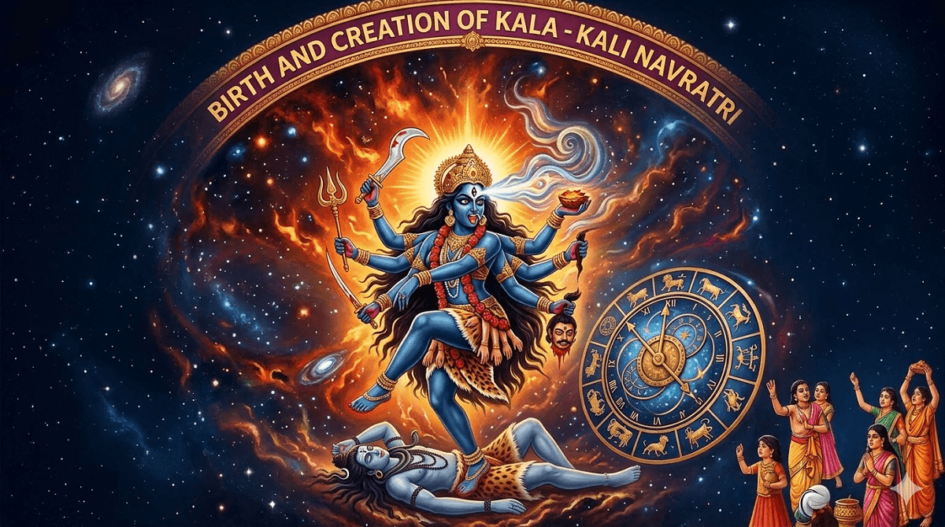
The Supreme Consciousness & the Birth of Kāla
In the beginning, the Supreme Consciousness is the One Reality Eternal. It holds all of existence within itself — in essence, without reference to time. Then creation begins: this Timeless Spirit extends itself outward to bring forth what is already implied within it. This self-extension, this objectivisation from a purely subjective state, measured by movement and event — this is what we call Time, kāla.
Time assumes a triple status — tredhā nidadhe padam — for creation and the created beings. !e experience of time as past, present, and future is a relative one, for the past was once the present, the present was once the future, and the future shall inevitably become past. Thus there is a continuous movement: an infinite continuum of apparently definite parts. These definite demarcations in the progression of successive development are the very characteristics of Time.
And to this characteristic — this relentless forward momentum, this structure of termination — we give the name Death. This is why, in the Sanskrit language, Death is also denoted by the same word: kāla. The Lord of Death is known as yama — the restrainer — as antaka, one who makes the termination, and as dharma, the law governing this mutable creation.
✦
Why Death is Not the Enemy of Life
The soul, having once limited itself by concentrating on a single moment and field of experience, is driven to seek its infinity again — by adding moment to moment, moving through successive fields, successive lives, accumulating knowledge, capacity, and experience. To this process, change of form is essential. For the soul involved in an individual body, change of form means dissolution of the body in subjection to the law of the All-life.
Death is necessary because eternal change of form is the sole immortality to which the finite living substance can aspire — and eternal change of experience, the sole infinity to which the finite mind involved in living body can attain.
— SRI AUROBINDO, THE LIFE DIVINE
It is only the process of Death — by dissolution and by the devouring of life by life — that makes variation of experience possible. The absence of freedom, the compulsion, the struggle, the pain: these are not the essence of death itself, but the sting of the sense of being devoured, broken up, destroyed by something that appears as Not-Self. This appearance is the illusion. The reality is something far more vast.
TANTRIC UNDERSTANDING
To this Supreme Time-force — the Śakti of Kāla — the Tantrics give the name Kālī. To the Tantric vision, this creation is no illusion. It is as real as the Creator. And in the process of winning the Godhead, they do not lose the world. theirs is not a mokṣa somewhere far beyond — their aspiration aims at liberation here and now, in the life itself. The Tantra therefore lays down the adoration of Kali, the Time-force, as the first and foremost of all disciplines of knowledge.
✦
The Dark Mother: Her Form & Her Meaning
Death prowls as a hungry beast devouring the whole of creation, sparing none. The Tantric sees the world as a great cremation ground — mahā śmaśāna. And in this mahā śmaśāna, the Divine Mother Kali dances. Her dance indicates the intense activity, the myriad moments of the Time-sequence following in quick succession. She is Death the devourer, the ruthless killer.
She is mounted on a dead body, terrible with ferocious fangs. A derisive laughter marks her face. Stark naked, the Dark One with her lolling tongue wears a garland of skulls. She holds the sword and the severed head in two of her hands — and in the other two, the auspicious Mother keeps for giving boons and allaying fear. Two personalities stand out in contemplation of this dark form: dakṣiṇa kālī and bhadra kālī.
- Kāla-Śakti : POWER OF TIME
- Dakṣiṇa Kālī: DIVINE DISCERNMENT
- Bhadra Kālī: THE AUSPICIOUS ONE
- Antaka: MAKER OF TERMINATION
- Pācaka Śakti: SHE WHO COOKS ALL
- Kuṇḍalinī: COILED EVOLUTIONARY POWER
Both dakṣiṇa and bhadra are Vedic words. Dakṣiṇa denotes divine discernment — a right action born of intuitional discrimination, an adroitness in execution. Kali carries the might of the Supreme, the stupendous strength of all the Gods, and she carries in her wake death and devastation. But she does this with divine discernment. Her act of destruction is not clumsy execution but a skilful performance, preparing the ground. So she is acclaimed as Dakshina
Kali.
And what does this ground prepare? All auspiciousness and felicity belonging to the state of truth — bhadram — is brought about by death and destruction. So she is also Bhadra Kali: the auspicious one who destroys in order to create.
✦
Kālī as Kuṇḍalinī: The Evolutionary Power Within
She is not only the cosmic force. She is deeply personal. She cooks everything in the cauldron of the cosmos — pācaka śakti — the eternal energy of evolution, Time the transformer. Successive deaths are only milestones in the highway of life, the thousand gates that open out to Eternity. Her darkness is the preparatory time of the night before the dawn.
In the being of the individual, she is the power of transformation — the dormant dynamism, the potential energy of evolution. She is the black serpent lying coiled and asleep in the inner body: Kuṇḍalinī Śakti. Under proper conditions this force uncoils itself, stands up straight like a serpent spreading its hood, and lifts itself more and more until it meets the divine consciousness above. When this takes place, the closed planes and parts of being in man open; there is a gradual unfoldment or a speedy transformation towards Yogic consciousness.
Whether one consciously makes an effort to raise the Kuṇḍalinī or not, in all paths of Yoga, at one time or other, the effects of her play are experienced in the inner body. Thus the grace of Kali is indispensable for any kind of transformation or progress — which is the avowed object of any Yoga.
✦
The Mantra, the Vīra & the Path of Worship
Kali the terrible is the Mother of might — deity of those who are mighty in mind and body. The path of the Vīra, Vīrācāra, is eminently suited for winning her favour. The hero-warrior repairs to a
cremation ground, takes his seat on a corpse, and fronts all those that are normally feared — attaining Siddhi. All those who are impatient with the tardy progress of life invoke Kali, for they feel that her blows beat what is rebellious into strength, hammer what is wry and perverse into perfect truth, and expel what is impure or defective.
The bījākṣara, the seed-mantra of Kali, is krīṃ. She is Kuṇḍalinī in the body expressing herself as activity through the Pranic force. The body and spirit are brought together by the life-force — the vital — whose outward symbol is the flowing breath, moving in and out of the body, all the time. The vital or Pranic force in the individual is a replica of the Pranic force in the cosmos, the Time-movement which is Kali. As the vital is the seat of emotions, all swift, straight, and frank
impulses, all intense feelings are the movements of Kali.
✦
S Ā DHANA
The method prescribed for winning the grace of Kali is to unite one’s consciousness constantly with the inflowing and outflowing breath. there is a vast difference between breathing involuntarily all the time and breathing knowingly even for a short while. By uniting one’s consciousness at each
step with inhalation and exhalation, one becomes conscious of the Pranic force that sustains one’s being — and then, the great cosmic Pranic force that is Kali. Adoring the Time-force thus, one understands what Sri Aurobindo called the mystery at the heart of existence:
SRI AUROBINDO · SAVITRI X.1
All here is a mystery of contraries;
Darkness a magic of self-hidden light,
Su!ering some secret rapture’s tragic mask
And death an instrument of perpetual life
Leave a Reply